Annual Reports
Doximity, Inc.'s annual reports contain management's most considered account of the business. These are the sections, passages and visual pages worth opening in the originals preserved in Sources.
Doximity, Inc. — FY2026 Annual Report (Form 10-K) — FY2026
The latest 10-K: management's fullest account of the physician-network-into-pharma-marketing model as it repositions around a Clinical AI Suite. · Open the full document →
Item 1. Business — Overview — p. 8 · Read the full section →
Defines what the company is and how the two-sided model turns a free physician network into paid pharma and health-system solutions.
Mission, physician-first design, and the Marketing/Hiring/Workflow revenue engine.
Our mission is to help every physician be more productive and provide better care for their patients. We are physician-first, putting technology to work for doctors instead of the other way around. That guiding principle has enabled Doximity to become an essential and trusted professional platform for physicians and their colleagues. We provide our members with AI-powered tools specifically built for medicine, enabling them to collaborate with colleagues, stay up to date with the latest medical news and research, manage their careers and on-call schedules, and conduct virtual patient visits. Our Clinical AI Suite supports the full day-to-day workflow of a physician, from patient communication to documentation to answering clinical questions. […] Our business model is designed to both respect and support our members while driving value for our customers through our Marketing, Hiring, and Workflow Solutions (as defined below). Our revenue-generating customers, primarily pharmaceutical manufacturers and health systems, have access to a suite of commercial solutions that benefit from broad usage by physicians and other medical professionals.
p. 8 · Read in context →
The network-effect flywheel management says is hard for competitors to replicate.
The ecosystem we have created in the medical community benefits from powerful network effects. Medical professional engagement with our platform increases as the breadth and utility of our tools expand, attracting even more members and driving broader and more effective communication and collaboration among healthcare professionals. This also drives greater value for our pharmaceutical and health system customers seeking to interact with specific groups of physicians and other medical professionals.
p. 8 · Read in context →
Our Solutions for Healthcare Customers — Marketing Solutions — p. 14 · Read the full section →
Shows who pays and how: brand-by-brand pharma and service-line health-system subscriptions, sold land-and-expand.
How Marketing Solutions are packaged and billed, and the land-and-expand motion.
We provide a digital marketing platform for pharmaceutical manufacturers and health systems on a subscription basis to serve our members with tailored sponsored content that is highly relevant to their clinical practices, including information about medications, clinical trials, guidelines and resources, and trends in medicine and patient care. Pharmaceutical manufacturers purchase programs on a brand-by-brand basis, and health systems execute programs on a service line-by-service line basis. […] We have become a valued collaborator to our customers, with a track record of expanding throughout the medication portfolios of pharmaceutical customers and into additional service lines throughout a health system, while also upselling additional modules.
p. 14 · Read in context →
Clinical AI Suite for Hospitals and Health Systems — p. 17 · Read the full section →
The newest strategic thrust: Ask, Scribe and Dialer bundled into an enterprise AI workflow adopted by 140+ health systems.
Enterprise adoption claim for the Clinical AI Suite.
More than 140 leading U.S. health systems have reviewed, approved through privacy and AI governance committees, and adopted the Clinical AI Suite, underscoring the enterprise-grade trust and compliance it delivers.
p. 17 · Read in context →
Item 1A. Risk Factors — p. 30 · Read the full section →
The two company-specific risks that could genuinely bite: revenue concentration and clinical-AI error liability.
Customer concentration — a single customer crossed 10% of revenue in FY2026, a new disclosure.
While one customer accounted for 10% or more of total revenue for the fiscal year ended March 31, 2026 and no customer met this threshold for the fiscal years ended March 31, 2025 and 2024, our revenue is relatively concentrated within a small number of key customers.
p. 36 · Read in context →
AI in a clinical setting: hallucinations and erroneous outputs carry outsized liability.
AI-enabled tools and features may produce outputs, recommendations, summaries, classifications, drafts, documentation, clinical reference responses, analyses, workflow-related content, or other materials that are inaccurate, incomplete, biased, offensive, misleading, or otherwise deficient. AI systems may also produce “hallucinations,” reflect errors or bias in training, input, or customer data, or behave unpredictably in response to incomplete, ambiguous, or adversarial prompts. Because our members and customers operate in the healthcare industry, errors or perceived errors in AI-enabled outputs may be particularly sensitive and could result in reduced trust in our offerings, member or customer dissatisfaction, reputational harm, contractual disputes, regulatory scrutiny, litigation, or other liability.
p. 50 · Read in context →
Item 7. MD&A — Overview and Key Metrics — p. 92 · Read the full section →
Management's own read on results: revenue and EBITDA at scale, but growth decelerating and net income down year over year.
Three-year revenue, net income and adjusted EBITDA — growth cooling from 20% to 13%.
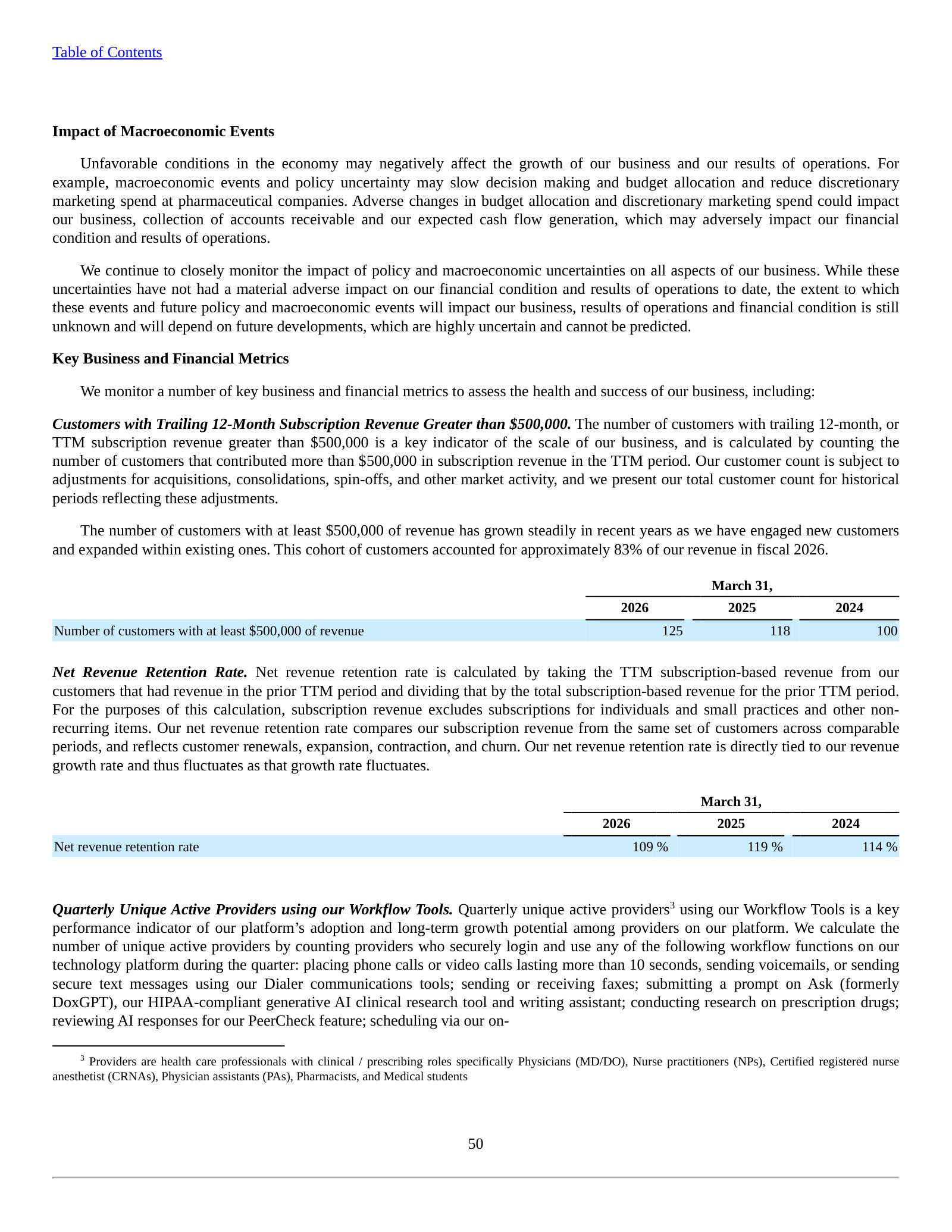
Our business model has delivered high revenue growth at scale with profitability. For the fiscal years ended March 31, 2026, 2025 and 2024, we recognized revenue of $644.9 million, $570.4 million, and $475.4 million, respectively, representing year-over-year growth rates of 13% and 20%, respectively. Our net income was $196.1 million, $223.2 million, and $147.6 million for the fiscal years ended March 31, 2026, 2025, and 2024, respectively. For the fiscal years ended March 31, 2026, 2025 and 2024, we generated adjusted EBITDA of $357.8 million, $313.8 million, and $230.5 million, respectively.
p. 92 · Read in context →
Item 7. MD&A — Results of Operations — p. 97 · Read the full section →
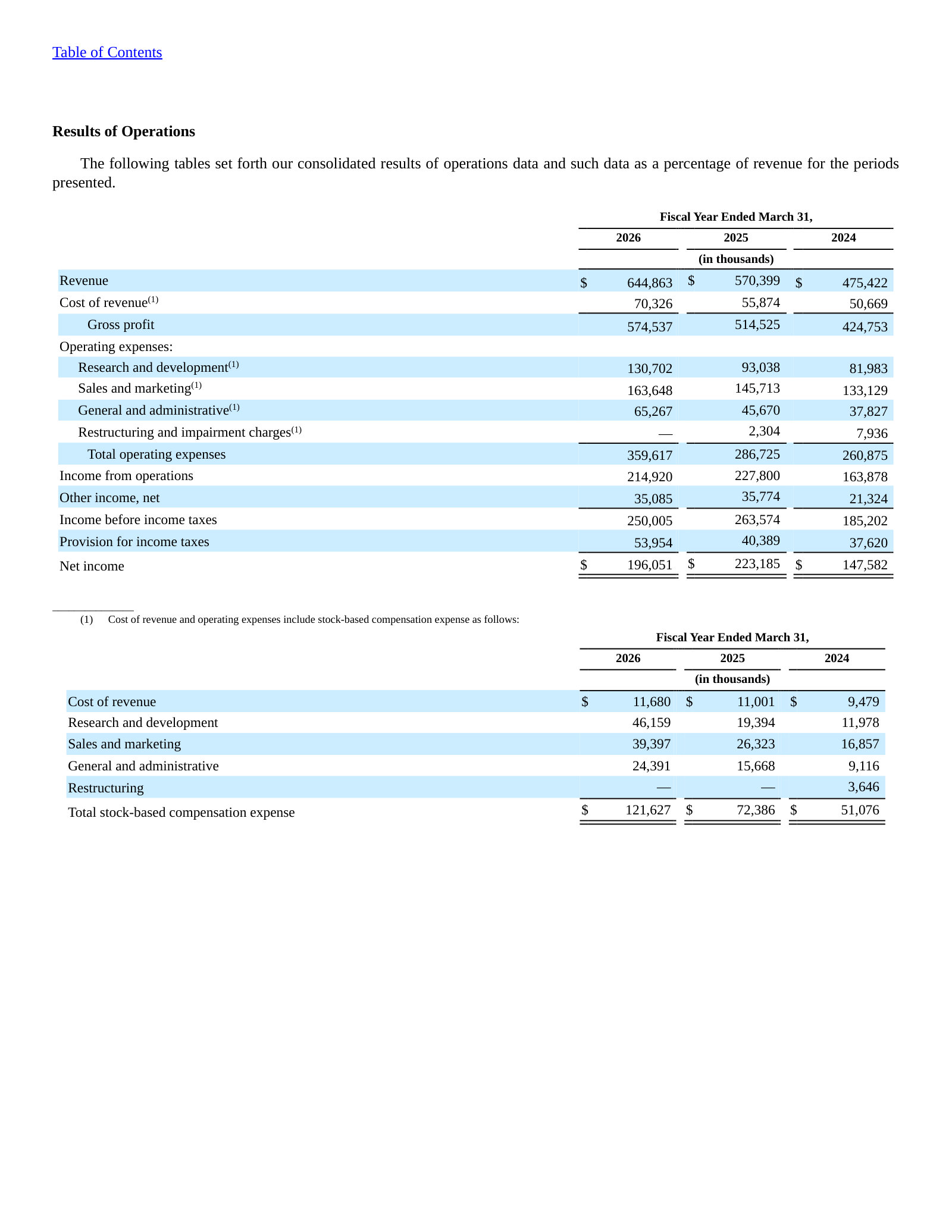
Where the numbers move: the P&L table exposes the stock-based-compensation surge that drove net income lower despite higher revenue.
Revenue bridge — expansion of existing customers, not new logos, drove most of the gain.
Revenue for the fiscal year ended March 31, 2026 increased $74.5 million as compared to the fiscal year ended 2025. The increase was primarily driven by a $64.6 million increase in subscription revenue. Of the increase in subscription revenue, $16.2 million was driven by the addition of new subscription customers and $48.4 million was due to the expansion of existing customers.
p. 99 · Read in context →
Critical Accounting Policies and Estimates — Revenue Recognition — p. 108 · Read the full section →
The subscription-recognition policy defines the model and is the auditor's designated critical audit matter.
Stand-ready vs. distinct-module subscriptions and how each is recognized over time.
Marketing Solutions customers may purchase integrated and other subscriptions for a fixed fee that are not tied to a single module per month but allow customers to utilize a given module or combination of modules during the subscription period subject to limits on the total number of modules launched in a given period of time, active at any given time, and members targeted. These represent standready obligations in that the delivery of the underlying sponsored content is within the control of the customer and the extent of use in any given period does not diminish the remaining services.
p. 108 · Read in context →
Doximity, Inc. — FY2022 Annual Report (Form 10-K) — FY2022
The first 10-K after the June 2021 IPO — a pre-AI baseline that shows how far the positioning has since shifted. · Open the full document →
Item 1. Business — Overview — p. 8 · Read the full section →
Same mission, framed as a 'physician cloud' of telehealth and workflow tools — no Clinical AI Suite, two million members not three.
FY2022 scale and reach: over two million members, 80%+ of U.S. physicians.
We are the leading digital platform for U.S. medical professionals, as measured by the number of U.S. physician members, with over two million medical professional members as of March 31, 2022. Our members include more than 80% of physicians across all 50 states and every medical specialty, as well as over 50% of U.S. nurse practitioners and physician assistants, and over 90% of graduating U.S. medical students.
p. 8 · Read in context →
The 'physician cloud' framing that predates the AI-first repositioning.
Doximity’s physician cloud puts modern software tools in the hands of physicians and other medical professionals. We provide our members with capabilities specifically built for medical professionals, enabling them to collaborate with their colleagues, securely coordinate patient care, conduct virtual patient visits, stay up-to-date with the latest medical news and research, and manage their careers.
p. 8 · Read in context →
More annual reports
Doximity, Inc. — FY2025 Annual Report (Form 10-K) — FY2025 · 162 pages · Peak-margin year (39% net margin, 20% growth, 119% NRR) — the comparison base for the FY2026 deceleration. · Open →
Doximity, Inc. — FY2024 Annual Report (Form 10-K) — FY2024 · 166 pages · Restructuring-charge year; early Clinical AI (DoxGPT) language begins appearing in the business description. · Open →
Doximity, Inc. — FY2023 Annual Report (Form 10-K) — FY2023 · 165 pages · First full post-IPO year; useful for tracking member growth and the pre-AI product mix. · Open →